Model, serial and lot identity
A device or a lot can be identified from the factory to the customer, and its components can be traced back.
Trace devices, service and commercial operations. Technical files, device history, installation, warranty and maintenance for makers, importers and distributors.
Choose by type of business; the Medical devices industry add-on costs $5,000 more.
A device or a lot can be identified from the factory to the customer, and its components can be traced back.
Installed equipment needs scheduled maintenance, calibration and a history that service staff can read.
The technical file of each model is kept complete and approved, with a view of what is still missing.
Built and demonstrated on sample data, and open in the demo system: request a demo and we issue an account. Limits, checklists and values in the demo are illustrations, not regulatory advice; each customer sets its own.
 (opens in a new tab)
A device or a lot can be identified from the factory to the customer, and its components can be traced back.
Installed equipment needs scheduled maintenance, calibration and a history that service staff can read.
The technical file of each model is kept complete and approved, with a view of what is still missing.
A complaint about a device has to reach quality, and any recall or field action needs the list of who received which lot.
A company picks several. Core fit means the type is a main target for this industry; depends on scope means it fits for some products or activities.
An illustrative process to discuss scope. It is not imposed on any company, and the software families named in each step are the ones that can take part.
Each model has a technical file that is approved before it is sold.
Devices are bought in or built; a device history record follows each lot.
Devices are held by lot with storage conditions.
Sales go to licensed customers; installation is planned with the customer.
Maintenance and calibration are scheduled and recorded.
The history of a device stays readable until it is retired.
Most important first. Each shows its real status.
Components, inspections and sterilization are recorded against the lot, and release rules stop a lot that is not ready.
The dossier of a model shows its readiness and what blocks QA approval.
The equipment module schedules preventive maintenance and calibration and keeps the history.
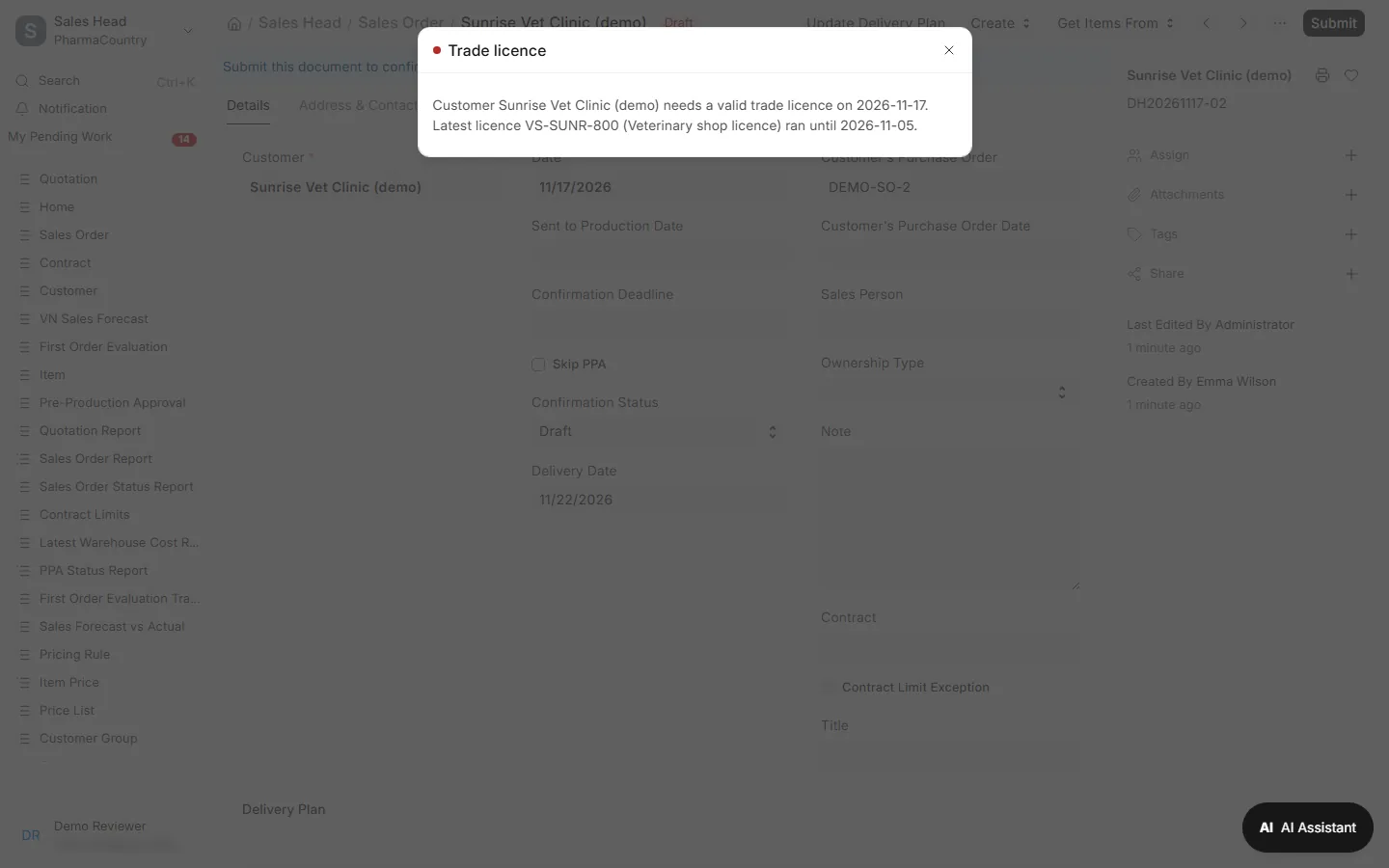
A sales order for a customer that needs a trade licence cannot be approved without a valid one.
These are examples of requirements that may apply, depending on the product, the activity and the market. They are not a claim that the software meets any of them.
Demo roles to ask for: QA Manager and QA Officer, Maintenance Manager and Technician, Distribution Manager
Signing in needs a demo account, issued after you request a demo. The data is sample data of a fictional company.
The ERP core carries serial and batch tracking and the equipment module keeps the maintenance history. A customer-by-customer installed-base view is scoped per project and is not part of the demo.
The technical-file dossier covers readiness and approval of the file for each model. Registration and UDI data are scoped per project; no specific market’s rules are built in.
Yes. Importers and distributors are among the main types of business: stock, licences, sales and service records without the production modules.
Describe your business and the processes you want to digitise. We reply with next steps.