Formula and ingredient control
A formula is a list of ingredients with amounts and limits; a change needs a new version and an approval.
Software for supplement brands, manufacturers and distributors. Formulas, claims, contract manufacturing, batch checks and multi-channel distribution for supplement brands and makers.
Choose by type of business; the Health supplements industry add-on costs $3,000 more.
A formula is a list of ingredients with amounts and limits; a change needs a new version and an approval.
Every claim on a label or a website points to the evidence behind it, and an unsupported claim is visible before launch.
A brand depends on the plants that make its product: orders, specifications, batch documents and release have to be tracked.
Built and demonstrated on sample data, and open in the demo system: request a demo and we issue an account. Limits, checklists and values in the demo are illustrations, not regulatory advice; each customer sets its own.
 (opens in a new tab)
A formula is a list of ingredients with amounts and limits; a change needs a new version and an approval.
Every claim on a label or a website points to the evidence behind it, and an unsupported claim is visible before launch.
A brand depends on the plants that make its product: orders, specifications, batch documents and release have to be tracked.
Test results are kept by lot, and a lot can be followed to the channels that received it.
A company picks several. Core fit means the type is a main target for this industry; depends on scope means it fits for some products or activities.
An illustrative process to discuss scope. It is not imposed on any company, and the software families named in each step are the ones that can take part.
The formula and its ingredients are drafted and versioned.
Limits, claims, evidence and the checklist are gathered and checked.
The order goes to the plant with the approved specification.
Test results and batch documents are reviewed against the specification.
Released lots enter stock with their expiry dates.
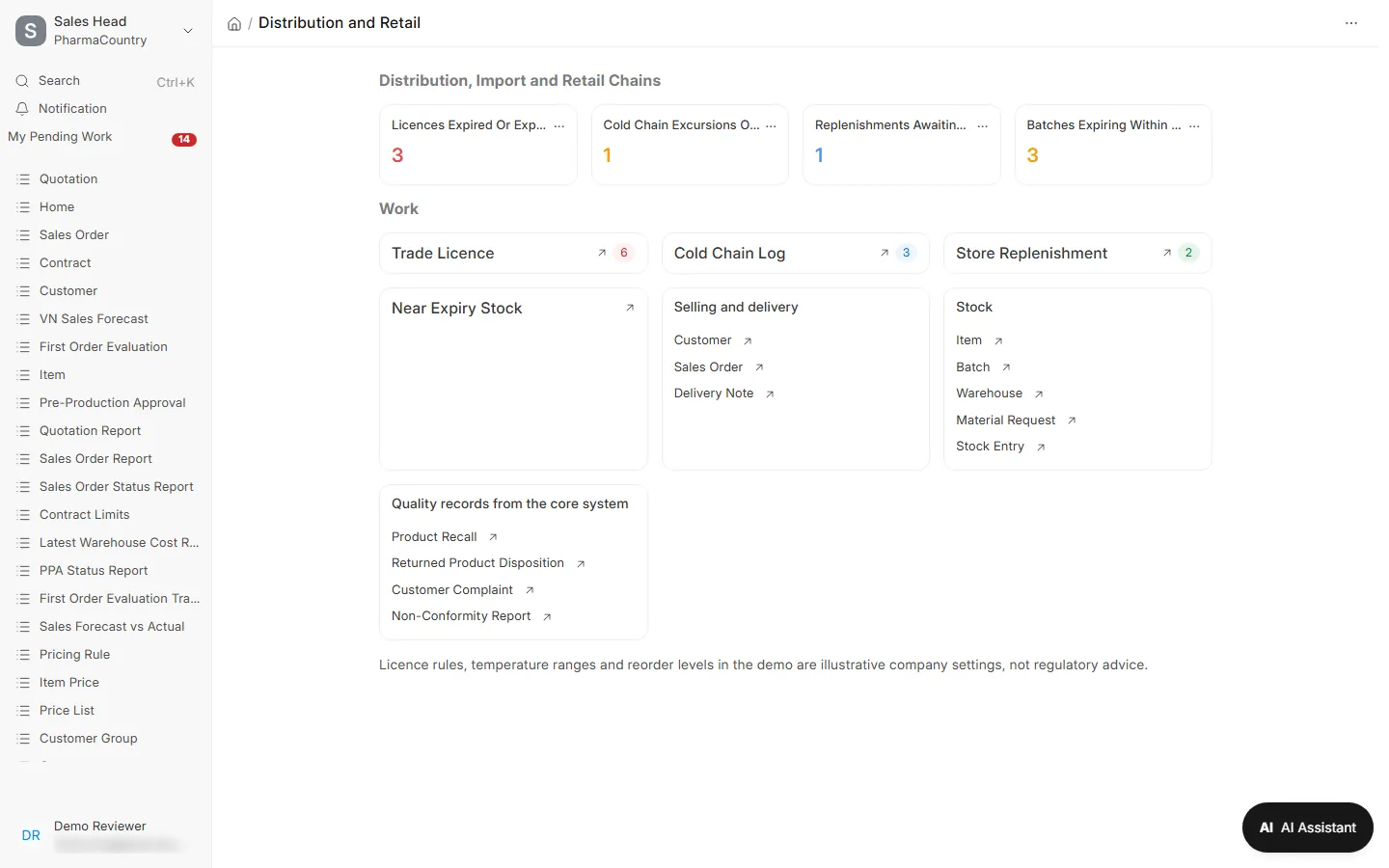
Stock is sold through distributors, retail chains and shops.
Most important first. Each shows its real status.
The readiness check lists open issues (a claim without evidence, checklist items still open) and blocks QA approval until they are resolved.
The formula is checked ingredient by ingredient against limits that your own team sets in the ingredient master.
A batch that is reworked has its own record with the reason, the steps and the quality approval.
A customer complaint records whether an adverse reaction is suspected, so it is handled as more than a service ticket.
These are examples of requirements that may apply, depending on the product, the activity and the market. They are not a claim that the software meets any of them.
Demo roles to ask for: R&D, Regulatory Affairs, QA Manager and QA Officer, Distribution Manager
Signing in needs a demo account, issued after you request a demo. The data is sample data of a fictional company.
Yes. Brand owners are one of the main types of business: the product dossier, the order to the plant, the quality checks and the distribution records stay in one system.
No. The demo contains an example ingredient master with illustrative limits. Each customer sets its own limits with its regulatory team; the software checks the formula against them.
Counter sales (POS) are planned and not yet delivered as a module; the ERP core has the standard features. Store replenishment and near-expiry stock are available in the distribution records.
Describe your business and the processes you want to digitise. We reply with next steps.